“Urban Eels Wins International Award for Planning”
Manawatu Standard 20th March 2022
Alongside being an Horizons Councillor, I run my own resource management consultancy, Gordon Consulting. I am delighted to share with you the news that “Urban Eels”, a partnership project between Gordon Consulting and Tanenuiarangi Manawatū Incorporated, won both a national and international planning award 2021 – the New Zealand Planning Institute Rodney Davis Project Award 2021 and Commonwealth Association of Planners Award 2021. Congratulations to all involved in this collaborative project.
………..
Palmerston North’s Urban Eels project is being noticed well beyond the groups of walkers on the He Ara Kotahi pathway between the Fitzherbert Bridge and Linton.
The viewing area created on the Turitea Stream just before it flows into the Manawatū River has been recognised by the Commonwealth Association of Planners with an award for outstanding planning practice.
And earlier, it won the NZ Planning Institute Rodney Davis project award in recognition of planning excellence.
For planner Fiona Gordon, who worked with Rangitāne, the city council and Horizons Regional Council to bring the $110,000 project to fruition in August 2020, it was “awesome” to see a small, local project competing and winning against international competition.
“It’s not just about the actual result, but about the planning that went into it.”
Tanenuiarangi O Manawatū Te Ao Turoa environmental officer Paul Horton said it was special that the relationships developed in creating an international-standard attraction had been recognised far from home.
He said the viewing platform was playing an important part in educating a wide community about the cultural significance of eels or tuna, and the need to protect them and their environment.
Once a rich food source, Rangitāne had themselves stopped using their cultural rights to take tuna from the waterways because of their low numbers and poor condition.
“One of the benefits of public engagement is that they will grow faster because they are being fed.”
At the moment it was taking close to 100 years for an eel to reach maturity and be ready to spawn.
The tuna were protected by a rāhui in place around the viewing platform, but Horton was aware they were still at risk in other parts of the waterways.
One of the eels had been seen with a head wound, suggesting somebody had tried to spear it.
“And unfortunately there has been someone who took the rāhui sign down and threw it away. But that does not get rid of it.”
Gordon said the planners had debated from early on whether providing access to the eels would create an opportunity for people to harm them.
But on balance, they decided getting more people to understand and care for the eels and their environment outweighed the risks.
“Indigenous Biodiversity Community Grants”
Horizons Regional Council Press Release 6th April 2022
“We would like to empower our communities to be part of ensuring our region’s ecosystems are healthy and vibrant.”
“The grants are a great opportunity for groups to tap into resourcing and support to kick start an idea or boost the impact of a project they already have underway.”
………….
Applications for Horizons Regional Council’s Kanorau Koiora Taketake – Indigenous Biodiversity Community Grants open on 11 April 2022.
These grants are open to iwi, hapū and community groups that have projects with outcomes to protect and enhance indigenous biodiversity, support connections between nature and people and the continuation of māturanga Māori (Māori knowledge).
Horizons councillor Fiona Gordon, a member of the committee who awards the grants, says the Council’s vision is to support projects that improve and restore biodiversity.
“We would like to empower our communities to be part of ensuring our region’s ecosystems are healthy and vibrant,” says Ms Gordon.
“This can be done in a number of ways, and we have a keen interest in long-term projects that include regenerating and protecting indigenous biodiversity, plus incorporate mātauranga māori.
“The grants are a great opportunity for groups to tap into resourcing and support to kick start an idea or boost the impact of a project they already have underway.”
Cr Gordon says Horizons hopes to see a range of applications from across the region.
“Last year the calibre of applications was really high with 21 grants awarded to a diverse range of community projects. These included restoration of wetland and dunes areas, expansions of mātauranga Māori within the community, predator control and planting programmes.
“Each of these initiatives are making a real difference, so the more projects Horizons can support the better – for biodiversity and our community. This year we have $240,000 available and applications are open until 1pm 9 May 2022.”
Cr Gordon says Horizons also has other community grant funding currently available that focusses on climate change.
“For any groups who have projects that look to build community or environmental resilience to the effects of climate change, I encourage them to take note of the inaugural Pūtea Hapori Urupare Āhuarangi – Community Climate Response Fund which is open until 31 May 2022.”
“Don Linklater Memorial Bursary Awarded”
Horizons Regional Council Press Release 10th September 2021
“The decision was made to encourage and support more people into study subjects directly aligned to Horizons business, and also acknowledging the need to encourage local iwi/hapū students into environmental studies.”
“These students are the future of environmental management in our region. Supporting them in their study contributes to investing in the future management of our natural resources.”
………….
Horizons Regional Council have awarded four environmental studies students with a Don Linklater Memorial Bursary for 2021.
The Don Linklater Memorial Bursary was established to honour the contribution made to the region by the late Don Linklater, who was Horizons Regional Council Chair from 1989 to 2000.
This year councillors agreed to increase the overall annual bursary to $8,000 and the number of potential recipients. The bursary was open for students studying at either undergraduate or postgraduate level.
Horizons councillor Fiona Gordon says that this decision was made to encourage and support more people into study subjects directly aligned to Horizons business, and also acknowledging the need to encourage local iwi/hapū students into environmental studies.
“These students are the future of environmental management in our region. Supporting them in their study contributes to investing in the future management of our natural resources,” says Cr Gordon.
Horizons councillor John Turkington says this year’s applicants were of an exceptional calibre, and we’re pleased to be able to provide the bursary to four of them.
“We’re pleased to announce our the successful recipients awarded for the 2021 academic year are Monique Corson, Gemma Fraser, Rochelle Lowe, and Meschka Seifritz,” says Cr Turkington.
Monique Corson is from Feilding and is studying a double major in Environmental Studies and Sociology at Massey University. She says that it’s important to understand both the physical happenings within the environment, and the human processes that are causing this change. Ms Corson wishes to help create and implement environmental policy that not only maintains and improves the state of our natural environment, but also maintains the wellbeing of the community within Aotearoa.
Meschka Seifritz is also from Feilding and is currently studying a Bachelor of Arts with a double major in Environmental and Māori Studies at Massey University. “I grew up colonised but found myself, my values and an incredible depth of knowledge within te ao Māori,” says Ms Seifritz. “I hope to combine western science and Matauranga Māori when considering New Zealand’s environmental issues throughout my academic and working career. Next year I will be starting my Masters degree in freshwater ecology, working with iwi, hapū and marae.”
Gemma Fraser is from Palmerston North and is studying at Massey University, working towards a career as a policy analyst. “I love the big picture thinking and problem solving that goes into sustainable resource management,” says Ms Fraser.
Rochelle Lowe also from Palmerston North wants to be an environmental lawyer and is studying a conjoint degree in a Bachelor of Laws and Bachelor of Science majoring in Environmental Science and Geology at Victoria University of Wellington. This combines her strengths and passions.
Applications for the 2022 funding round will open early next year.
“Maori Wards Vote Historic Moment”
Manawatu Guardian 28th May 2021
Opinion:
May 19 marked a historic moment for Horizons Regional Council and for Māori across our region.
The council’s decision to establish Māori constituencies (wards) has set a new scene for the 2022 local elections. It is a scene that reflects fairer democratic representation and the opportunity to bolster the building of an enduring and productive partnership around the council table.
Over the past month I have heard comments dismissive of the need for Māori constituencies, the reason being that there are already many ways that tangata whenua and Horizons are working together.
It is true the council has a range of arrangements and relationships with hapū and iwi in our region. These are important, necessary and beneficial arrangements with tangata whenua which can certainly help to move the council towards co-governance.
But establishing Māori constituencies is different, and it is important we recognise this.
Establishing Māori constituencies is about the representation of Māori and about guaranteeing representation of Māori in local government.
There have also been comments that establishing Māori constituencies is a divisive exercise. It does quite the opposite. It actually brings us together by guaranteeing that people representing the Māori community will be in the council boardroom making decisions on behalf of our community, collectively, as councillors.
It’s important to recall the option of establishing Māori constituencies was developed by Parliament to enhance the role of Māori in local government. This recognised the Crown’s responsibility to take appropriate account of the principles of Te Tiriti o Waitangi and to maintain and improve opportunities for Māori to contribute to local government decision-making processes.
This was reinforced by a Human Rights Commission recommendation that the Māori voice be heard and represented in local government.
Yes, it was time for Horizons to establish Māori constituencies.
Nāku te rourou, nāu te rourou, ka ora ai te iwi.
(With your basket and my basket the people will live.)
• Fiona Gordon is a Horizons regional councillor for the Palmerston North constituency.
“Domestic Abuse: Shielded Site Offers Safety and No Digital Footprint”
Manawatu Guardian 12th October 2020
“Violence against women is perhaps the most shameful human rights violation, and it is perhaps the most pervasive. It knows no boundaries of geography, culture or wealth. As long as it continues, we cannot claim to be making real progress towards equality, development and peace.” – The late Kofi Atta Annan, Ghanaian diplomat and 7th Secretary-General of the United Nations.
Domestic violence is the nemesis of dignity, fairness, equality, respect and autonomy. It is also a crime.
Ending domestic violence is everybody’s business and I consider local government to be well positioned to take a leadership role within their communities.
That’s why earlier this year I teamed up with Dr Ang Jury, chief executive of Women’s Refuge New Zealand, in a bid to encourage local government to boost their efforts towards combatting domestic violence.
Ultimately we would like to see all councils nationwide hosting the Women’s Refuge New Zealand Shielded Site on their websites.
The Shielded Site is a web-based portal that provides women with access to essential information privately and without fear that their abusers, who may be monitoring their victim’s browser history, will know they have been reaching out.
It has a web-chat function too, allowing women to connect with specialists in family violence to receive advice in real time, while maintaining absolute confidentiality and leaving no digital footprint.
Local Government New Zealand were quick to respond to our call, hosting the Shielded Site on their own website and then spreading the word in their nationwide newsletter.
The National Council of Women New Zealand kindly included an article in their June newsletter and last month I personally wrote to every mayor and chair across the country.
I’m super pleased to report that Horizons Regional Council and all seven local councils within the Manawatū-Whanganui region now host the Shielded Site.
Coverage across our whole region is a significant milestone and I’m hopeful it might inspire other regions to do the same.
So far the number of councils hosting the Shielded Site has increased from around eight in April to 49.
This is great progress but I’m conscious that with 78 councils nationwide we can still do better.
Councils play a key role in providing for the wellbeing and safety of communities during any crisis and sadly, domestic violence has amplified amid the Covid pandemic.
It is vital that anyone experiencing domestic violence has safe and secure avenues to reach out through for help.
Hosting the Shielded Site is a simple yet effective measure every council can choose to take.
I can’t think of any reason a council would choose not to host it, certainly not once they are aware of the valuable service it can provide our communities.
– Fiona Gordon is a Horizons Regional Council councillor for Palmerston North.
“Political Catch Up” with Fiona Gordon
Manawatu People’s Radio 25th June 2020
Fiona Gordon – Live interview with Fraser Greig. Discussion on the removal of free lunches from Horizons meetings, the Linklater Bursary, Climate Change and the Women’s Refuge Shielded site initiative.
“Women in science – Don Linklater Memorial Bursary opens”
Manawatu Guardian 17th June 2020
I can still recall trying to explain to my grandmother what exactly I was studying at university.
The expectations and opportunities of the world she grew up in were so different to mine – her female friends and family members included farmers, teachers and nurses.
These were careers she could easily identify with.
But my desire to learn led me in another direction, into the world of physical geography, environmental planning, environmental science, even industrial and organic chemistry.
Decades later and I am now the one trying to get my head around the vast choice of study topics my children have available to them.
Just last week at a Horizons Regional Council meeting, I felt I could have been sitting in a university lecture again, and I loved it.
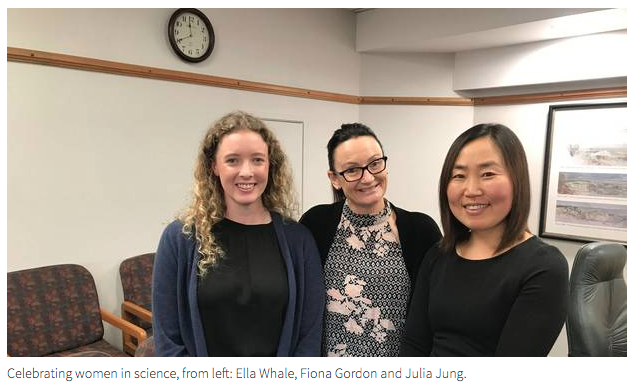
As river management analysts, Ella Whale and Julia Jung, presented their research into sediment and gravel deposits in our rivers and floodways.
I soaked up all their graphs, maps and calculations – a showcase of the incredible depth of knowledge that feeds into managing our natural resources.
The expertise required is not confined to river and drainage basin dynamics, extending into environmental planning, resource management, and engineering among other areas.
With world-class tertiary education right on our doorstep, including Massey University, the Universal College of Learning, Te Wānanga o Aotearoa and IPU New Zealand, there are likely many students from Horizons’ region studying relevant topics here, as well as those choosing to study outside our region too.
I’m honoured to be on the Don Linklater Memorial Bursary panel, now open for applications until July 10.
The bursary is valued at $3000 a year, for up to three years, and aims to support students studying in areas relevant to Horizons Regional Council.
I’d like to encourage all students from Horizons’ region to check out if this might be the bursary opportunity for you.
I’d also like to take a moment to celebrate women in science.
To rise to the challenges of the 21st century, we need to harness our full potential – yet at present, less than 30 per cent of researchers worldwide are women.
While still underrepresented, it is heartening to see an increased movement of women into science, technology, engineering and mathematics (STEM) – and into politics for that matter – both signs of positive change and two more things I would have had to explain to my grandmother.
Don Linklater Memorial Bursary application forms are available from http://www.horizons.govt.nz, Horizons Regional Council’s office in Palmerston North or by calling free phone 0508 800 800.
“Shielded: Safe online site for those experiencing domestic violence”
Manawatu Guardian 4th May 2020
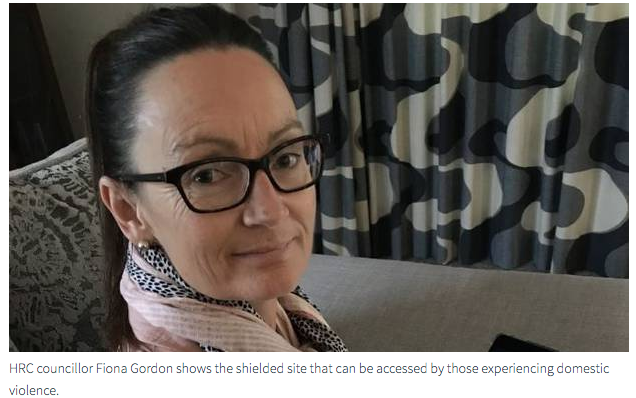
Horizons’ Councillor Fiona Gordon has teamed up with Dr Ang Jury, Women’s Refuge New Zealand chief executive, to ask all Councils nation-wide to host the Shielded Site – a safe, untraceable portal for victims of domestic violence to get help.
“We can all share in a sense of relief that the Covid-19 pandemic curve has steadily fallen,” says Cr Gordon.
“What should rightly disturb us however is the domestic violence curve which has been steadily creeping upwards.
“So much so that domestic violence has been dubbed the ‘second, silent epidemic’ amid the lockdown.”
Cr Gordon said the marked increase in the number of women making contact with Women’s Refuge is a trend highly likely to continue, even as the lockdown provisions ease.
“Even more concerning is that support workers say that the stories worrying them most are the ones they aren’t hearing about at all.
“For women experiencing family violence, living in the same bubble as their abuser can be extremely dangerous to try to reach out for help if the abuser becomes aware of what is happening.
“With social distancing measures in place, reaching out through traditional methods such as phone and email may not be a safe option.
“This is why the Women’s Refuge Shielded Site is so vital,” says Cr Fiona Gordon.
“The web-based portal allows women to secretly access essential information and advice without fear that their abusers, who may well be monitoring their victim’s browser history, will know they have been reaching out.
“Now with a new web-chat function, women can immediately be in touch with specialists in family violence to receive advice and assistance in real time – all while maintaining absolute confidentiality and leaving no digital footprint.”
Dr Jury and Cr Gordon have jointly written to Local Government New Zealand asking all 78 councils nation-wide to add the Shielded Site to their websites.
Their letter has garnered wide support from Councillors at both Horizons Regional Council and Palmerston North City Council.
“Hosting the Shielded Site is such a simple yet effective measure,” says Cr Gordon. “It can make reaching out for help easier and safer.
“Obviously, the more websites that choose to host it, the better.”
HRC last week actioned Cr Gordon’s request to host the Shielded Site on the Horizons’ website.
This prompted inquiry from City Councillor Rachel Bowen who ensured Palmerston North City Council quickly followed suit.
“We need as many avenues as possible for people to seek help safely.”
Should your business wish to host the Shielded Site visit http://www.shielded.co.nz
“Our Kids Need More Heroes”
Press Release 22nd August 2019
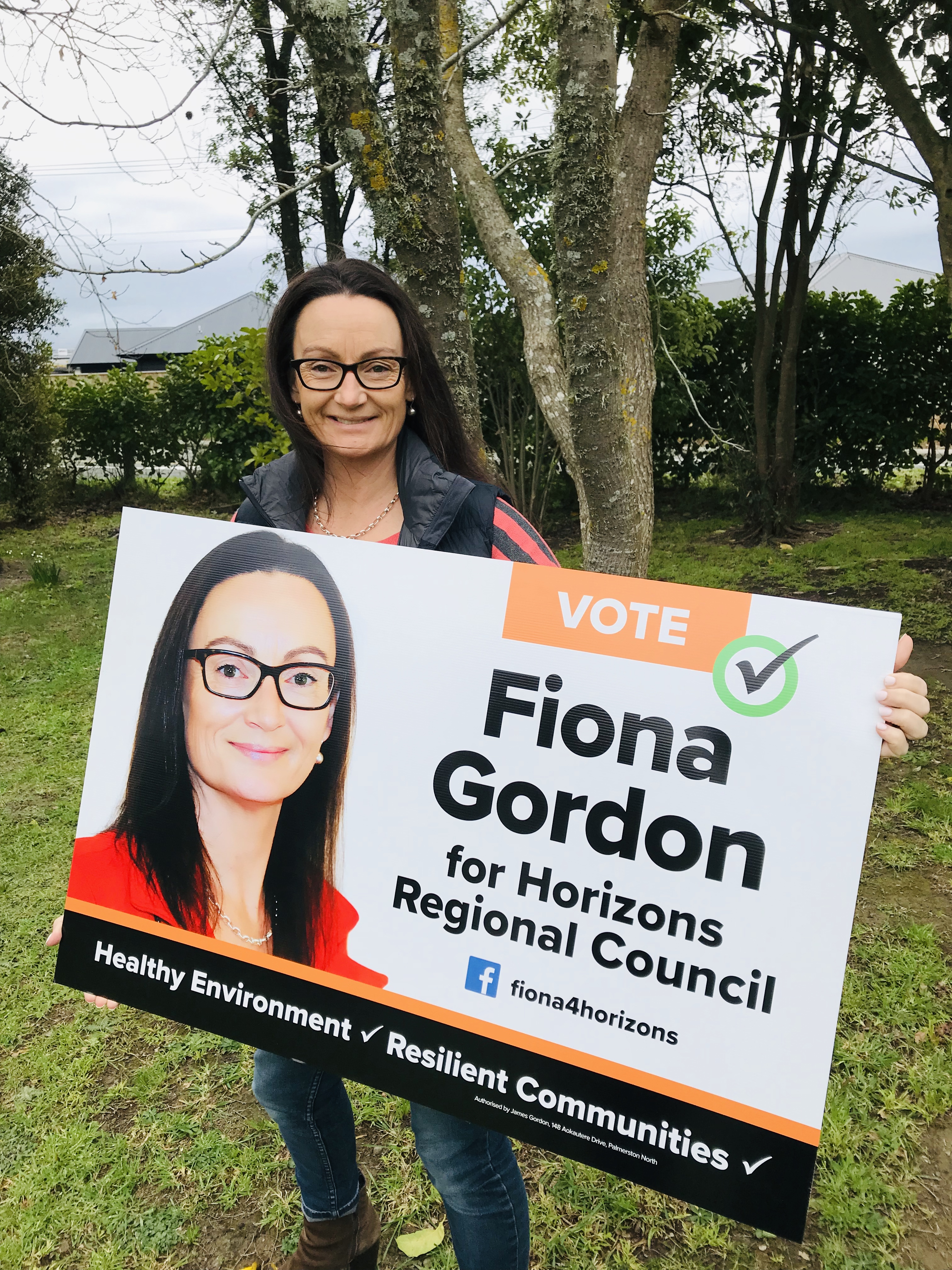
Local business owner and mum of two, Fiona Gordon, is vying for one of four Palmerston North seats on Horizons Regional Council in the 2019 local body elections.
“I live here because I love it – the lifestyle, the people, the landscape. But our environment is not being adequately safeguarded.” The latest Horizons’ reports show, “we have come a long way, but there is still much work to do.”
Many of our rivers, lakes and beaches are still unsafe for swimming and the few forest remnants and wetlands we have left are not yet fully protected and managed. “We now face climate change impacts too,” says Fiona, “including more flood events, droughts and lower summer-time river levels.”
“Our kids want a future beyond climate change, they want clean rivers and oceans, less waste and no more species extinctions.””
“A seat on the Regional Council is about shaping regional leadership and making good decisions based on honest and reliable information,” she says. “If we don’t know something we need to be frank about that, look to fill information gaps and act with caution in the meantime.”
With a professional background in resource management, policy development, local government and experience working with community groups, Iwi, NGOs and business, Fiona is particularly keen to see more avenues for impactful, well-resourced partnerships to flourish.
As a Trustee to the Palmerston North City Environmental Trust and as an Ambassador to the Jane Goodall Institute New Zealand, Fiona has seen first-hand, “just how many everyday heroes there are out there developing amazing community-led initiatives focused on environmental outcomes.”
Fiona believes many of these initiatives have potential for positive economic spin-offs too. However, she’s concerned that, “with funding opportunities typically over-subscribed, some initiatives are missing out from reaching their full potential.”
“We know relying on rules and regulations alone won’t be enough to right this ship,” says Fiona, “increasing partnerships with our communities has potential to move us much closer to our region’s environmental and economic goals.”
“We need to connect the dots between environmental goals and economic development opportunities” and Fiona considers agencies like Accelerate 25 and the Central Economic Development Agency to be well positioned to enable this.
When studying the then ‘ground-breaking’ Resource Management Act at Massey University in 1991, Fiona had expected to see resource use that wouldn’t compromise the needs of future generations. “It’s clear our resource management decisions have led us off course,” she says.
“I’m stepping up, with a big dose of courage and hope for my generation’s children and their children. I’m offering to bring my skills to the table to help make sensible, future focused decisions for a healthy environment and resilient communities.””
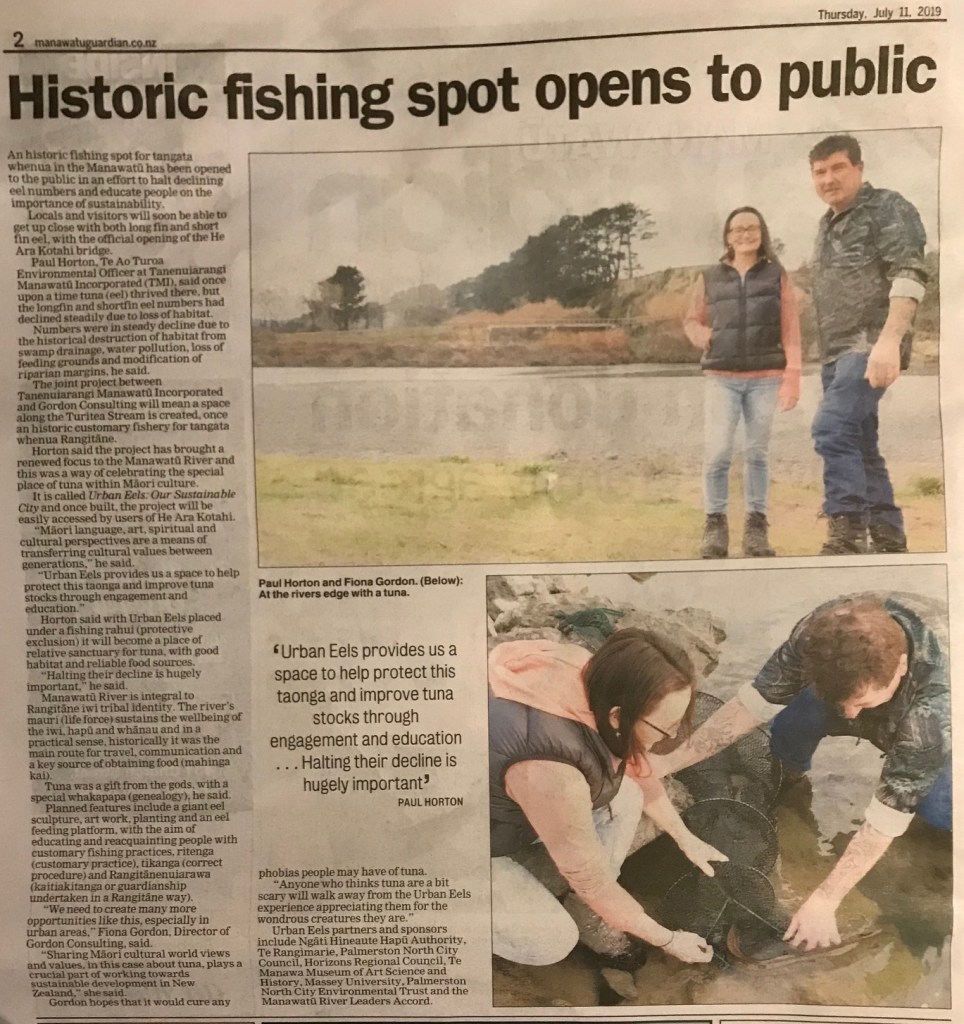
“Historic fishing spot opens to public”
Manawatu Guardian 11th July 2019
“Sharing Maori cultural world views and values, in this case about tuna, plays a crucial part of working towards sustainable development in New Zealand.” – Fiona Gordon.
A joint project between Tanenuiarangi Manawatū Incorporated (TMI)) and Gordon Consulting is set to create a space along the Turitea Stream, an historic customary fishery for Rangitāne the tangata whenua, that celebrates the special place of tuna (eel) within Māori culture. Called “Urban Eels: Our Sustainable City” once built, the project will be easily accessed by users of He Ara Kotahi.
Tuna once thrived here, but the longfin and shortfin eel (tuna kawharuwharu or tuna reherehe) in te taperere nui a Whatonga (The Great District of Whatonga) have steadily declined due to the historical destruction of habitat from swamp drainage, water pollution, loss of feeding grounds and modification of riparian margins.
“We need to create many more opportunities like this, especially in urban areas.” – Fiona Gordon.
Manawatu Guardian 4 July 2019
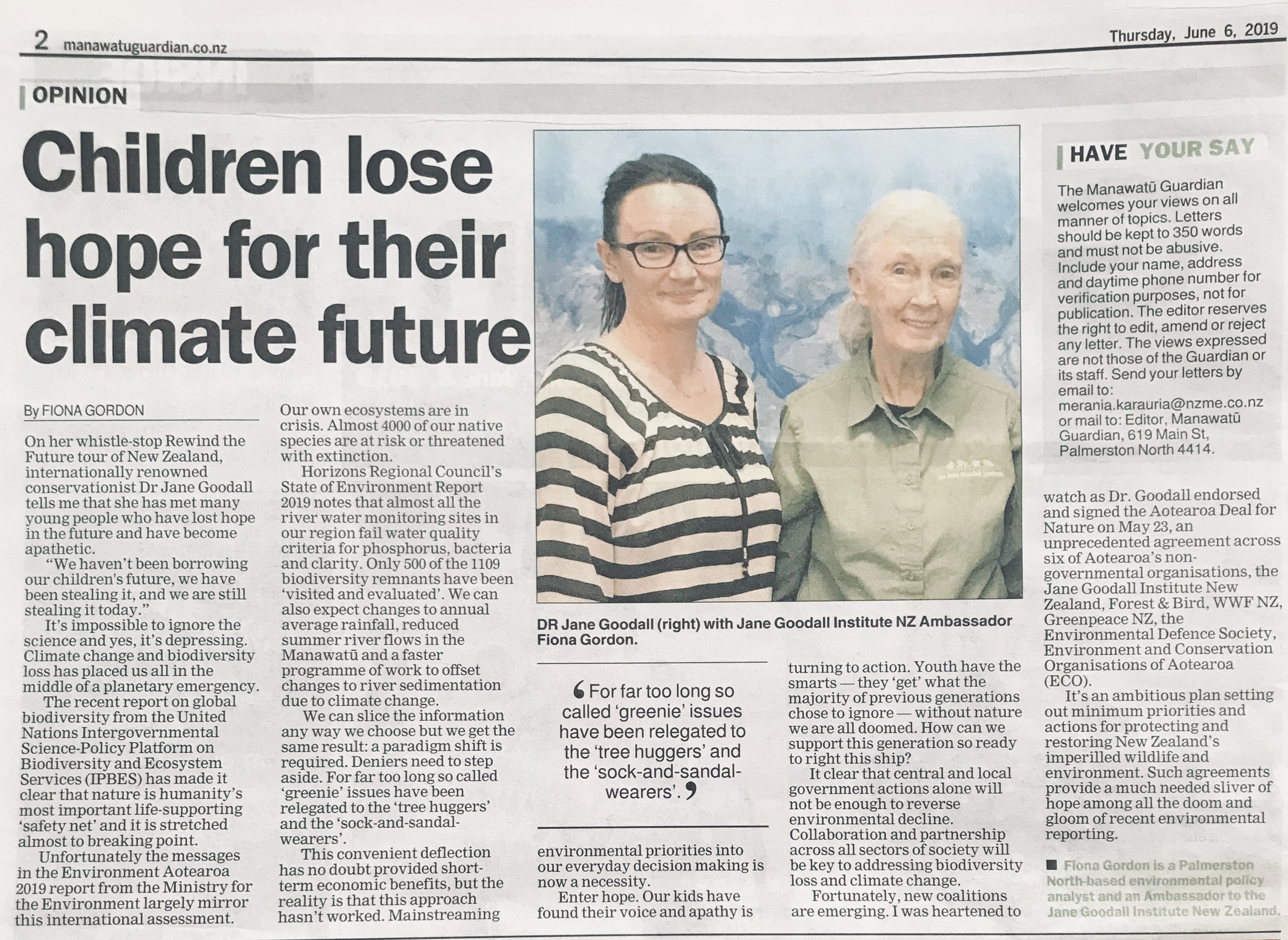
“Science Says Nature Is Good For Us”
Op Ed Published Manawatu Guardian 4th July 2019
Just as temperatures dip into the “it’s too cold to get out of bed” territory, the winter solstice arrived to mark the shortest day of the year. Any of us feeling a little blue about winter can now look forward to each day getting longer (and hopefully warmer) towards Spring.
But if you seek more of a pick-me-up, new research published this month suggests that just a two-hour ‘dose’ of nature a week significantly boosts health and wellbeing.
Even better, the findings from the UK and Sweden suggest that simply sitting and enjoying the peace has mental and physical benefits.
This is probably something we don’t really need science to tell us this. Who doesn’t feel good after visiting the new He Ara Kotahi bridge, walking Te Apiti or just sitting in the park to soak up a little winter sunshine?
To be fair though, this is the first ever major study delving into precisely how long is needed to produce these health benefits. Apparently it doesn’t matter whether the two hours in nature are taken in one go or in a series of shorter visits, or whether people go to an urban park, woodlands or the beach.
Based on interviews with 20,000 people the research shows that the benefits were the same for both young and old, wealthy and poor, urban and rural people, those with long-term illnesses or living with a disability.
It’s also been suggested that the quality of the natural environment, in terms of plant and animal species richness, is important too. Research indicates that experiences may be even better in more biodiverse settings.
The researchers say that more studies are a critical next step towards developing any ‘recommended weekly nature exposure’ guideline for health and well-being gain – much like existing guidelines on weekly physical activity.
These findings add greatly to our knowledge about the value of our natural environment, values that need to be widely understood if we are to successfully resource the protection and enhancement of nature into the future.
Here in the Manawatu then, we have a gold-mine of health and well-being right on our doorstep, from Pit Park, Ahimate Reserve and Ashhurst Domain, to Foxton Beach, Tararua Forest Park and Totara Reserve (to name a few). Significant resources we need to nurture and invest in.
If we didn’t know it already, we know it now – reconnecting with nature is good for the soul. We just need to throw on that warm jacket and get out there to reap the benefits!
Fiona Gordon Fiona Gordon is a Palmerston North based environmental policy analyst and an Ambassador to the Jane Goodall Institute New Zealand.
Op Ed Published in Manawatu Guardian 4 July 2019
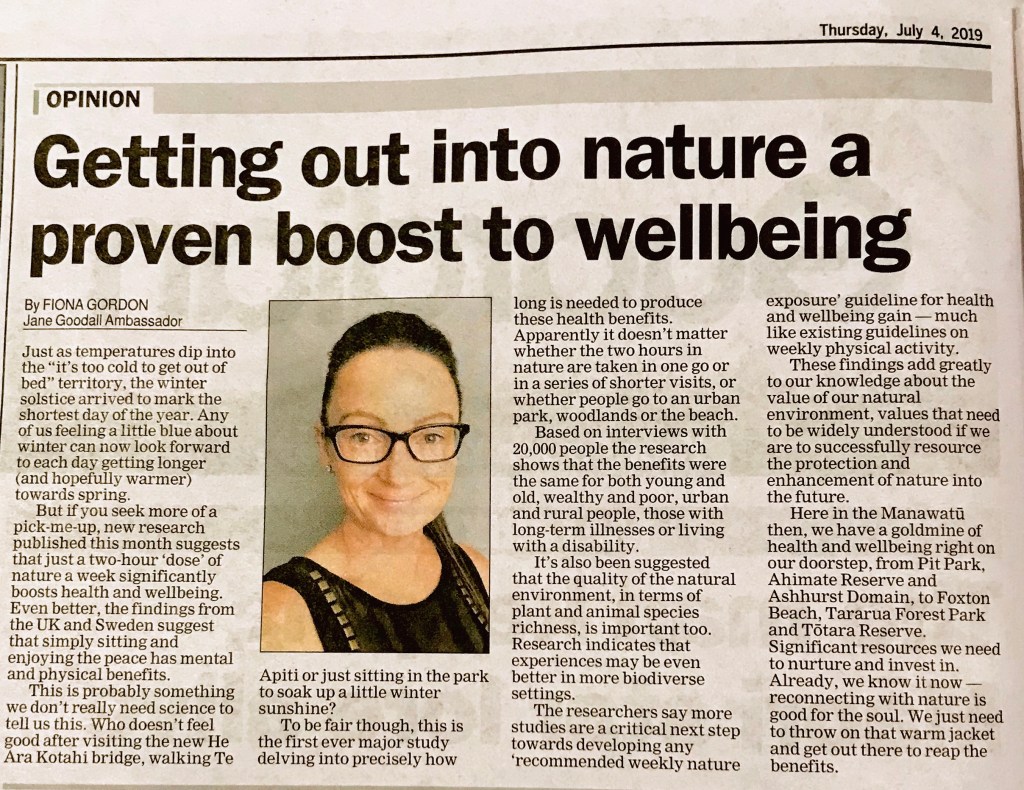
“Stealing Their Future”
Op Ed Published Manawatu Guardian 6th June 2019
On her whistle stop “Rewind the Future” tour of New Zealand, internationally renowned conservationist Dr. Jane Goodall tells me that she has met many young people who have lost hope in the future and have become apathetic. Dr. Goodall then makes a poignant point “we haven’t been borrowing our childrens’ future, we have been stealing it, and we are still stealing it today.”
Indeed, it’s impossible to ignore the science and yes, it’s depressing. Climate change and biodiversity loss has placed us all smack-bang in the middle of a planetary emergency.
The recent report on global biodiversity from the United Nations Intergovernmental Science-Policy Platform on Biodiversity and Ecosystem Services (IPBES) has made it clear that nature is humanity’s most important life-supporting ‘safety net’ and that ‘safety net’ is stretched almost to breaking point.
Unfortunately the messages in the Environment Aotearoa 2019 report from the Ministry for the Environment largely mirror this international assessment. Our own ecosystems are in crisis. Almost 4,000 of our native species are at risk or threatened with extinction.
Horizons Regional Council’s State of Environment Report 2019 released on 28 May, notes that almost all the river water monitoring sites in our region fail water quality criteria for phosphorus, bacteria and clarity. Only 500 of the 1,109 biodiversity remnants have been ‘visited and evaluated’.
We can also expect changes to annual average rainfall, reduced summer river flows in the Manawatu and a faster programme of work to offset changes to river sedimentation due to climate change.
We can slice and dice the information any which way we choose but we get the same result: a paradigm shift is required. Remaining deniers need to step aside. For far too long so called ‘greenie’ issues have been relegated to the ‘tree huggers’ and the ‘sock-and-sandal-wearers’.
This convenient deflection has no doubt provided short term economic benefits, but the reality is that this approach hasn’t worked for any of us.
Mainstreaming environmental priorities into our everyday decision making is now a necessity, for people and planet.
Enter, hope. Our kids have found their voice and apathy is turning into action. Youth have the smarts – they ‘get’ what the majority of previous generations chose to ignore – without nature we are all doomed. So, how can we support this generation so ready and willing to right this ship?
It clear that central and local government actions alone will not be enough to reverse environmental decline. Collaboration and partnership across all sectors of society will be key to addressing biodiversity loss and climate change.
Fortunately, new coalitions are emerging. I was heartened to watch as Dr. Goodall endorsed and signed the Aotearoa Deal for Nature on 23 May, an unprecedented agreement across six of Aotearoa’s non-governmental organisations, the Jane Goodall Institute New Zealand, Forest & Bird, WWF NZ, Greenpeace NZ, the Environmental Defence Society, Environment and Conservation Organisations of Aotearoa (ECO).
It’s an ambitious plan setting out minimum priorities and actions for protecting and restoring New Zealand’s imperilled wildlife and environment. Such agreements provide a much needed sliver of hope amongst all the doom and gloom of recent environmental reporting.
Fiona Gordon Fiona Gordon is a Palmerston North based environmental policy analyst and an Ambassador to the Jane Goodall Institute New Zealand.
Op Ed Published in Manawatu Guardian 6 June 2019
 Fiona Gordon